Pauline Kael wrote of “the higher trash and the lower trash”. Some films which are quite enjoyable but are classics of all that is shoddy and second-rate and cliche-ridden and monumentally banal. But enough high-faluting snobbery, sometimes one needs a good dose of lower trash fun, here are a few choice ones …

 LOVE HAS MANY FACES
 – a deliriously exotic artefact from 1965 and currently my favourite Lana Turner epic. The best thing about it actually is the theme song sung by Nancy Wilson. Lana, looking glazed throughout, is dressed by Edith Head (though that’s no recommendation anymore after the other period films like
A HOUSE IS NOT A HOME she dressed in atrocious early 60s styles) and plays a wealthy playgirl in Acapulco married to ex-beach boy gigolo Cliff Robertson.

They drink a lot as the police find the body of another beach boy who it seems Lana knew. Hugh O’Brian in skimpy speedos lingers while waiting to get off with Lana, as he trains his room-mate, another bottle blonde beach boy, in how to be a gigolo. Enter Ruth Roman
[right, with O'Brian], a dame who knows the score and is willing to pay for her pleasures, with her pal Virginia Grey. Stephanie Powers is the young innocent trying to find what happened to the dead beachboy, and she and Cliff are drawn together. They all go off to a bullfight and ….. but no, I cannot describe how this delirious farrago ends. Its certainly one to cherish though, as directed by Alexander Singer who also did A COLD WIND IN AUGUST and PSYCHE 59. Ruth is terrific, I must see more of her ...
 SYLVIA
 – One of those Joe E Levine [the Mogul of the Mediocre] mid’60s melodramas which the studios were turning out in a desperate attempt to get with it as the Swinging 60s took off, but ended up looking more dated than ever. Thank heavens the like of BONNIE AND CLYDE were just around the corner. Here, old hand Gordon Douglas directs Carroll Baker (in her Harlow phase) as the poetess Sylvia West who is engaged to Peter Lawford (playing a sleazeball as usual) who hires private eye George Maharis to track down the background of the mysterious Sylvia. This is quite enjoyable actually as cue cameos from Edmund O’Brien, Joanne Dru as an ex-hooker who married well, Ann Sothern hilariously overblown, Aldo Ray as Sylvia’s abusive father, Viveca Lindfors as a possibly lesbian librarian, Nancy Kovack as a brassy showgirl and Lola Diamond, a very scary drag queen. Baker is quite nice here as the rose-growing poet untouched by her sordid past, and there is a perfect theme song by Paul Anka. Ok, its trash but in a good way. Its in black and white with that nice mid-60s feel.
 HARLOW
 – The movie I love to hate - only
THE OSCAR is worse, and why, pray, is it called HARLOW? We learn nothing about the real Harlow – her first and later marriages are not mentioned, and neither are Gable, Powell, Hughes or any of her films. Carroll Baker is nothing like Harlow, there is no attempt, apart from a few old cars, to re-create the 1930s and Baker looks like a 60s vamp and seems to be doing the twist at one stage, to Neal Hefti’s muzak score. The hair is all wrong too. The men are all over the hill: Mr Sleaze Peter Lawford is the husband who kills himself, Red Buttons the agent who promotes her, and one trusts Angela Lansbury and Raf Vallone got handsome paychecks and enjoyed themselves for appearing as her parents.

Poor Jean, frustrated in love, picks up a guy and full of disgust falls drunk into the surf at Malibu, catching pneumonia as the waves wash over her …. And then she dies prettily in hospital. Was that really what happened to Harlow ? Another 1965 release, directed – or should I say assembled – by hack Gordon Douglas, and bizarrely scripted by John Michael Hayes. At least
VALLEY OF THE DOLLS is presented as a trash classic, but was this really meant to be taken seriously?
 HARLOW
 – the OTHER HARLOW film from 1965, a cheapo effect in black and white, but its actually a whole lot better. Carol Lynley is made up more in the 1930s style and looks more like Jean than Baker. Its competently directed by Alex Segal, Ginger Rogers is a barn-storming Momma Jean with Barry Sullivan as her husband, with Hurd Hatfield, Efrem Zimbalist and it does try to recreate the ‘30s with Hermione Baddeley as Marie Dressler and look-alikes for Laurel and Hardy and others. It’s a whole lot of fun actually. Both HARLOWs are essential if you want to run a trash classics all-nighter for your friends’ amusement ….
 WHY MUST I DIE?
 – I wouldn’t bother with rubbish like this normally, but given it as a swop recently (by my IMDB buddy Timshelboy), I had to have a look. It’s a real curiosity now, this 1960 knock-off of
I WANT TO LIVE two years earlier, was directed by Roy Del Ruth and produced by and stars Terry Moore in another grim downbeat look at capital punishment. Its hilariously awful in every respect as Terry apes Susan Hayward’s suffering in Robert Wise’s far superior classic. Terry is a good girl gone wrong but decides to leave her sleazy hood of a boyfriend and moves away and becomes a classy chanteuse in an upmarket supper club – but her past catches up with her when Eddy and his new moll – Debra Paget – track her down and force her into helping them rob the joint. Things go wrong when Debra shoots the owner, Terry’s current beau, and Terry gets framed for the murder and sent down. Unrepentant bad girl Debra (who snarls her way through her scenes and wears Capri pants and stilettos) then shoots a helpless blind man while raiding a grocery store and she too end up in the slammer but won’t confess to the murder which Terry, who is now on death row, is condemned for. Will the other inmates break mean Debra down in time before Terry fries in the electric chair? It sets out the rituals of execution, as in the Wise film, and the ending is a surprise. Tawdry cheap noir doesn’t get much cheaper.
 SOS PACIFIC
 – Guy Green’s 1959 thriller is a neat British entry (rather like a superior B-movie) in the “doomed flight” type of movies that were popular back then (Warner’s
THE CROWDED SKY though remains the best, but
BACK FROM ETERNITY also delivers, I must try and re-see
JET STORM, also 1959 where Richard Attenborough has the bomb on the plane, piloted by Stanley Baker, with a great cast of the time). This one features a rackety sea-plane piloted by dependable John Gregson with Pier Angeli as the stewardess, tough guy Eddie Constantine is the anti-hero and Richard Attenborough in one of the sleazy roles he played back then is the con man on the run. Add in Eva Bartok as a playgirl down on her luck and Jean Anderson as the prim older lady. Our motley crew crash land near a deserted Pacific atoll (in shark-infested waters….) and discover its going to be the target for an atomic bomb test in a few hours. Can they disable the signal in time ….. Its nicely worked out – I enjoyed it when I saw it as a kid, fun to see again now.
 A GIRL NAMED TAMIKO
 - In between churning out those action hits like THE MAGNIFICENT SEVEN and THE GREAT ESCAPE John Sturges also helmed some surprising choices like the Lana Turner sudser
BY LOVE POSSESSED and this choice item from 1962: A GIRL NAMED TAMIKO. I can only presume Sturges and the cast signed on for the trip to Japan [probably a rarity back then], as a lot of it does look like it was shot there and not by the second unit.
1962 was one of Laurence Harvey’s busier years what with this, THE MANCHURIAN CANDIDATE and WALK ON THE WILD SIDE and that unseen Cinerama Grim(m) film. Here he is, if you please, as a half-Russian and half-Chinese but is still the same Laurence Harvey we know and love, going through the film with a pained expression (maybe to signify the Chinese or Russian part of his character?) as the photographer willing to go to any lengths for that visa to America. Its set in Tokyo among the expat colony, but Miyoski Umeki would seem to be only real Japanese involved. France Nuyen as Tamiko, whom Larry falls for, is actually half-French, half-Vietnamese (and she looked a lot prettier as Liat back in SOUTH PACIFIC). Martha Hyer though sizzles as the girl from the Embassy (a variation on her country club girl roles) with the hots for Larry. Good to see Michael Wilding and Gary Merrill gainfully employed in supporting roles. An interesting curiosity then, courtesy of Hal Wallis. It isn't really that racy even if
the poster screams: "He was half oriental, but he used the women of two continents without shame or guilt!"  WALK ON THE WILD SIDE
 – Harvey again in another lulu from 1962 and one of the best trash classics ever, as directed by Edward Dmytryk with that pounding Elmer Bernstein score and that great credit sequence with the prowling cat. (Jazzman Jimmy Smith also had a hit with this theme). Laurence Harvey, as expressionless as ever, hunts for his lost love Capucine in the bordellos of New Orleans in the 1930s, from the well-known novel by Nelson Algren. The movie is quite tame though but the cast are fascinating: young Jane Fonda as Kitty Twist, on the road with Harvey and later in the cat house owned by Barbara Stanwyck who wants haughty sculptress Capucine for herself. There is something fascinating about Capucine, I just like watching her. Anne Baxter has a supporting role here as Teresina, the Italian café owner, who would like Harvey to stay on with her. It all comes to a steaming climax at Stanwyck’s cathouse … one to savour then.
 THE CARPETBAGGERS
 – I really enjoyed this when re-saw it recently. It’s a trash classic made by experts: again directed by Dmytryk in ‘64, script by John Michael Hayes, dressed by Edith Head and another Bernstein score (which sounds rather like a rehash of Walk On the Wild Side). Its enormous fun as Jason Cord (the man you love to hate, as portrayed by George Peppard) discovers why he is such a heel and tries to destroy everyone. Its of course a variation on the Howard Hughes story as novelised by Harold Robbins, and is much more fun than Scorsese’s attempt on the Hughes story in THE AVIATOR. Alan Ladd turns in his final role as the cowboy Nevada Smith (who Steve McQueen also portrayed), Carroll Baker is rather wasted as the Jean Harlow type star, Martin Balsam and Robert Cummings deliver great characters and Martha Hyer comes in late and is sensational, then there is Elizabeth Ashley as Peppard’s real love interest. It plays like a cartoon strip and is terrific fun, even now.
 THE SINGING NUN
 – this 1966 monstrosity has been kept hidden for the last 40 or so years here in the UK, until TCM UK decided to haul it out of mothballs for our enjoyment. Is there a more enjoyably awful bad movie? Its tragic in a way, considering what happened to the real Singing Nun, whose “Dominique” was one of the first records I bought as an early teen. Here we have Debbie Reynolds in her worst performance as the simpering sister playing her guitar in Belgium. Add in Greer Garson as the condescending Mother Superior, Agnes Moorehead as the crotchety nun and
IMITATION OF LIFE’s J

uanita Moore is lost as the happy black nun, Chad Everett is Debbie’s ex-beau, and Ricardo Montalban is an unsufferably cheerful priest. Katharine Ross puts in an early appearance. The ending is downright laughable as Sister Debbie gives up her music as it was taking her away from her vocation, and there she is like a Madonna (or Madonna) holding up a naked black baby in Africa as the natives adore her. Old hand Henry Koster makes this one a religious movie to laugh at. The laugh is on MGM if they thought their happy nun film would equal the success of 20th's
SOUND OF MUSIC!
 THE LOVE MACHINE
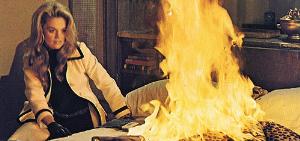
 – Perhaps the trashiest of trash classics? This 1971 potboiler by Jack Haley Jr from Jacqueline Suzann’s novel was an absolute treat to finally see this year! Like THE OSCAR it is just appalling on every level, as impassive Robin Stone (John Philip Law,
left with Cannon and Hemmings) schemes to become the head of a televisison station, using everyone in his way, but meet his match in Dyan Cannon as the ruthless wife of tycoon Robert Ryan (who lends dignity to his role). Dyan demands a key to Law’s apartment so she can call in whenever she wants but naturally she is not pleased to drop by and find him having a threesome in the shower with two young nubile lovelies, so of course she douses the bed in petrol and sets the room ablaze.

Then there is David Hemmings enjoying himself hugely as the very gay and camp photographer (a twist on his
BLOW-UP persona perhaps?) who also has the hots for John – the film comes to a hilarious climax as he, his pink-clad boyfriend, Dyan and Law fight for an incriminating bracelet that will prove Law is a “fag” (the word must have been in common usage then, as Dyan tosses it around all the time) which means Dyan can get him sacked from his tv post! The girl playing Amanda the model is also terrible and comedian Shecky Greene is unbearable [like Tony Bennett in THE OSCAR]. A hooker is brutally beaten up by our ‘hero’ and as for the homophobia … there is though a nice Dionne Warwick theme song!
Perhaps I should also endeavour to catch up with
DOCTORS’ WIVES,
THE OTHER SIDE OF MIDNIGHT and
ONCE IS NOT ENOUGH ? Though too much trash can make one very queasy …
 A QUIET PLACE IN THE COUNTRY
 – an “arty” choice to finish with. This Elio Petri (he also directed INVESTIGATION OF A CITIZEN ABOVE SUSPICION) 1969 film reunites lovers Vanessa Redgrave and Franco Nero from CAMELOT and is a riot of late 60s symbolism – any film that

begins with Franco Nero in his underpants tied to a chair with rope, as Vanessa enters casually removing her panties and then proceeds to bite his nipples has to be worth a look. Is it a dream or one of the mad artist’s delusions? It makes one wonder if respected elderly thespians (Franco and Vanessa are married now) look back in amazement at what they were paid to do as the Swinging 60s drew to a close and the counterculture collapsed. If so, they will have a ball watching this one. Vanessa went on to perform that deformed nun in Ken Russell's
THE DEVILS while Franco went Romany in
THE VIRGIN AND THE GYPSY. Redgrave and Nero are presumably more staid now as they are reunited in this new rom-com
LETTERS TO JULIET...
Here's a link to Franco in a jockstrap from one of those euro movies that never showed up here in London: http://www.youtube.com/watch?v=d-lOPgxDDQc
Next: back to art house: Antonioni's IL GRIDO, Visconti's SANDRA, Bergman's THE MAGICIAN, Truffaut's LE PEAU DEUCE.


 She has been a fixed presence in my moviegoing since the mid-60s: MORGAN, BLOW-UP, THE SAILOR FROM GIBRALTAR, ISADORA, CAMELOT, THE DEVILS, THE CHARGE OF THE LIGHT BRIGADE, JULIA, THE TROJAN WOMEN and through to cameos in HOWARD'S END, THE WHITE COUNTESS, ATONEMENT etc, not to mention her delirious A QUIET PLACE IN THE COUNTRY in '69 with Franco Nero (now her husband). I have only caught a few of her stage performances but she was astounding in a delicious '70s DESIGN FOR LIVING (photo at Vanessa Redgrave label) and A MADHOUSE IN GOA sometime in the 80s. She is very lucid too on the making of BLOW-UP in a BBC documentary showing how Antonioni showed her how he wanted her to sit and move and stand. Her autobiography is a revealing read too covering not only her theatrical heritage, the Tony Richardson years and later. Her late sister Lynn was also a particular favourite of mine, as per Lynn Redgrave label.


 She has been a fixed presence in my moviegoing since the mid-60s: MORGAN, BLOW-UP, THE SAILOR FROM GIBRALTAR, ISADORA, CAMELOT, THE DEVILS, THE CHARGE OF THE LIGHT BRIGADE, JULIA, THE TROJAN WOMEN and through to cameos in HOWARD'S END, THE WHITE COUNTESS, ATONEMENT etc, not to mention her delirious A QUIET PLACE IN THE COUNTRY in '69 with Franco Nero (now her husband). I have only caught a few of her stage performances but she was astounding in a delicious '70s DESIGN FOR LIVING (photo at Vanessa Redgrave label) and A MADHOUSE IN GOA sometime in the 80s. She is very lucid too on the making of BLOW-UP in a BBC documentary showing how Antonioni showed her how he wanted her to sit and move and stand. Her autobiography is a revealing read too covering not only her theatrical heritage, the Tony Richardson years and later. Her late sister Lynn was also a particular favourite of mine, as per Lynn Redgrave label.